

How To Clean Your Computer Of Viruses Mac
If your Macbook or iMac slows down, your screen is inundated with annoying ads, your browser settings change, or there's a weird increase in your system'due south Internet activity, then it is possible that you have malware installed on your computer. This guide teaches you how to remove all types of Malware from macOS for free by post-obit easy footstep-by-pace instructions.
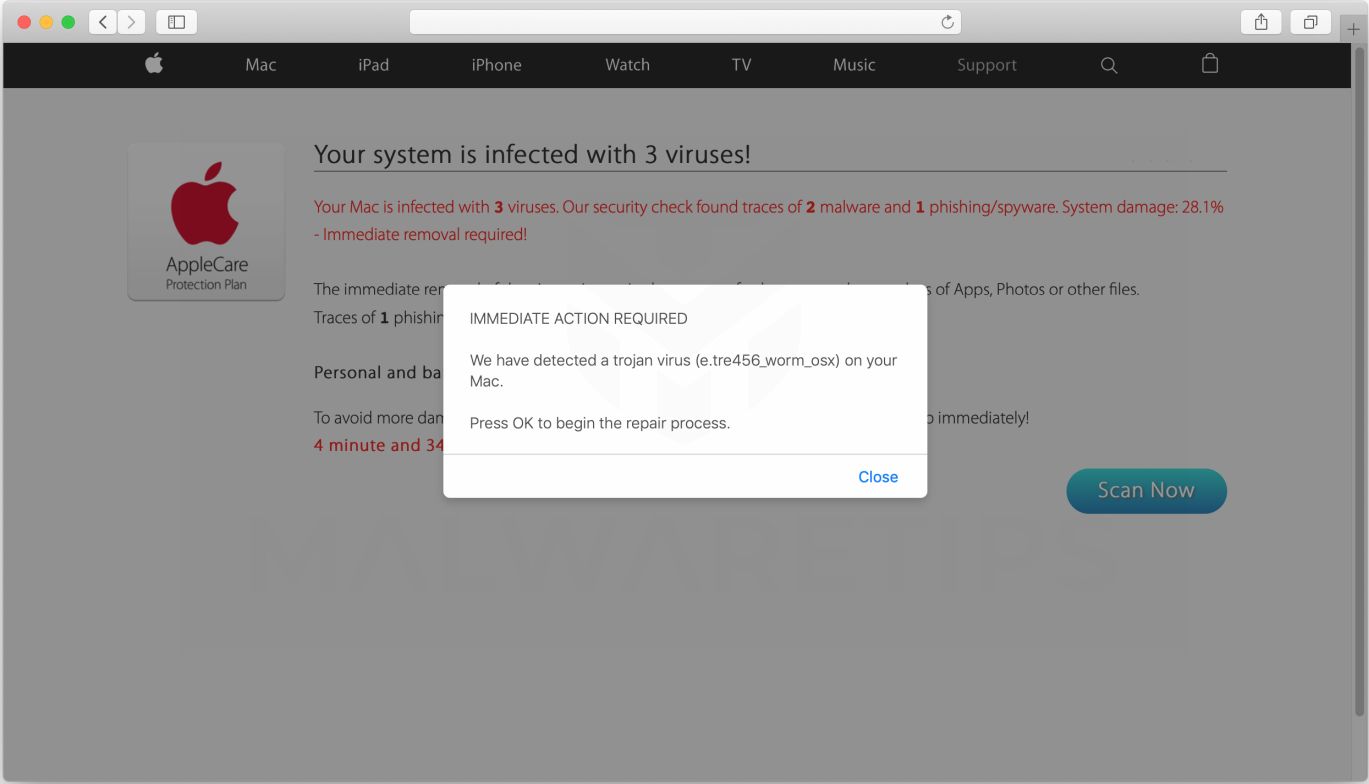
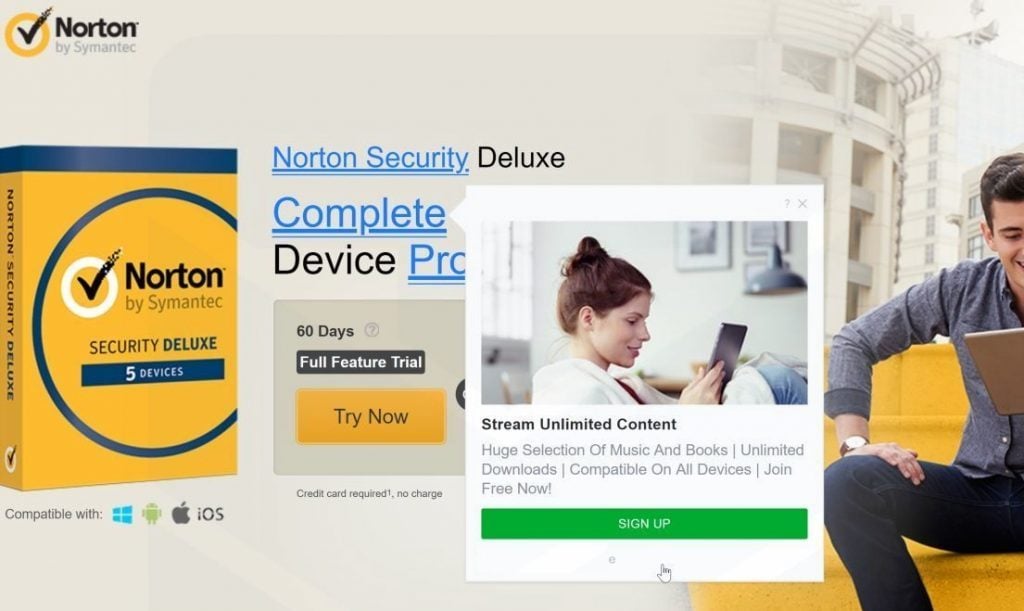
Can Macs become infected with malware?
Adware, browser hijackers, and unwanted apps are these days able to infect fifty-fifty the macOS operating system. These types of infections are designed specifically to brand money. They generate web traffic, collect sales leads for other dubious sites, and volition display advertisements and sponsored links within your web browser.
Once a malicious program is installed on your Mac, unwanted advertisements will pop up on your figurer, unknown programs are installed on your device, or your browser settings will be changed without your consent.
When malware is installed on macOS, mutual symptoms include:
- Advertisements appear in places they shouldn't be.
- Your web browser'southward homepage has mysteriously inverse without your permission.
- Spider web pages that yous typically visit are not displaying properly.
- Website links redirect to sites dissimilar from what you expected.
- Browser popups appear which recommend fake updates or other software.
- Unwanted programs are installed without your knowledge.
This guide was written to assistance Mac users remove adware and browser hijackers from their devices, if your simply looking for a manner to block or remove advertisements from the sites y'all visit, then y'all can employ a gratuitous browser extension like AdGuard.
How did my Mac get infected with malware?
Malicious apps or browser extensions are installed past the users, whether that is knowingly or not. Often, these types of programs are offered through advertisements or bundled with other software, leaving the user puzzled where this software came from.
Unfortunately, some free downloads practice not adequately disclose that other software will as well be installed and y'all may find that yous have installed a malicious program without your knowledge.
You lot should always pay attention when installing software because often, a software installer includes optional installs. Be very careful what you concord to install.
Always opt for the custom installation and deselect anything that is not familiar, especially optional software that you never wanted to download and install in the beginning identify. It goes without proverb that you should non install software that you lot don't trust.
To check your macOS computer for malware and remove information technology for complimentary, please use the guide below.
How to remove Malware from macOS (Virus Removal Guide)
This malware removal guide may appear overwhelming due to the number of steps and numerous programs that are being used. We have only written it this way to provide clear, detailed, and easy-to-understand instructions that anyone can apply to remove malware for free.
Please perform all the steps in the correct order. If you have whatsoever questions or doubt at whatsoever point, stop and inquire for our assist.
To remove all types of malware from your macOS, follow these steps:
- STEP one: Remove malicious Profiles from your Mac
- Pace two: Remove malicious apps from Mac
- STEP 3: Employ Malwarebytes Free to remove adware and other malware
- Stride 4: Remove browser hijackers from Safari, Chrome, or Firefox
Stride 1: Remove malicious Profiles from your Mac
Profiles are used by IT admins in businesses to control the behavior of their Macs. These profiles tin can configure a Mac to practice many different things, some of which are not otherwise possible.
When it comes to home users, adware and browser hijacker are using the configuration profile to prevent users from removing malicious programs from the computer. This also prevents the user from changing that behavior in the browser's settings.
In this first pace, nosotros will check your computer to see if whatever configuration profiles are installed. To practice this, follow the below steps:
-
Open "Organisation Preferences"
From the Apple tree carte, select Organization Preferences….
-
Search for "Profiles"
When the System Preferences window opens, search for the Profiles icon.
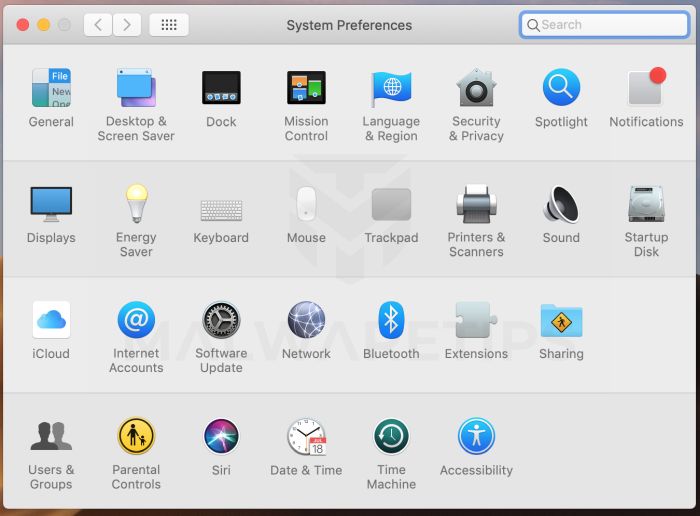
If there isn't a Profiles icon, you don't have any profiles installed, which is normal and you tin continue with the side by side steps.
-
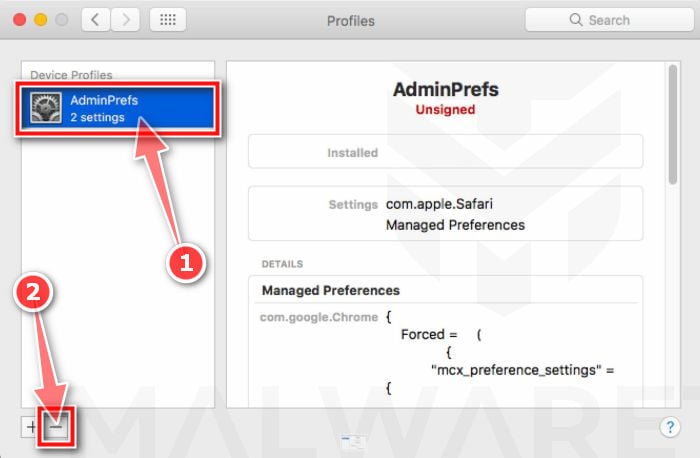
Remove the malicious profiles
If there'south a Profile icon, click on it and select whatsoever suspicious profile that yous want to remove, then press the – (minus) button. Click Remove to remove the profile.
STEP ii: Remove malicious apps from your Mac
In this next stride, nosotros will try to identify and remove any malicious apps and files that might be installed on your figurer.
-
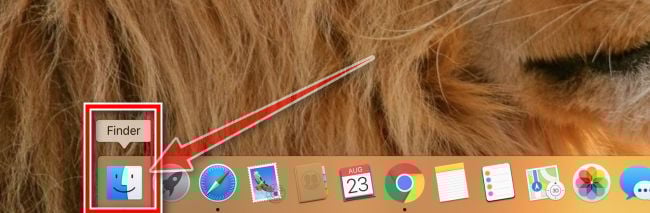
Open "Finder"
Click the Finder application on your dock.
-
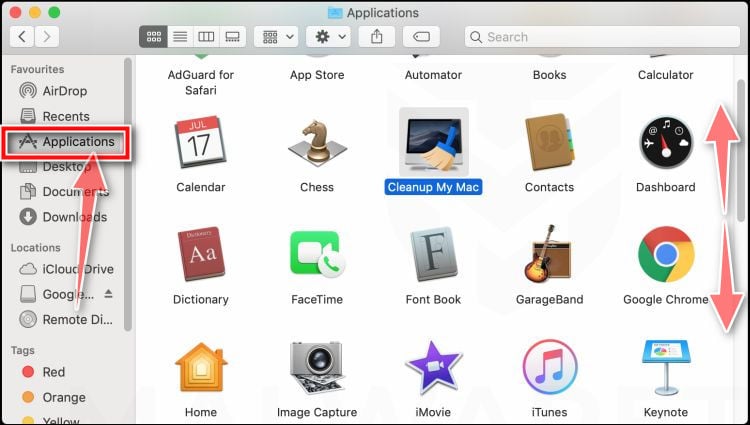
Click on "Applications"
In the Finder left pane, click on "Applications".
-
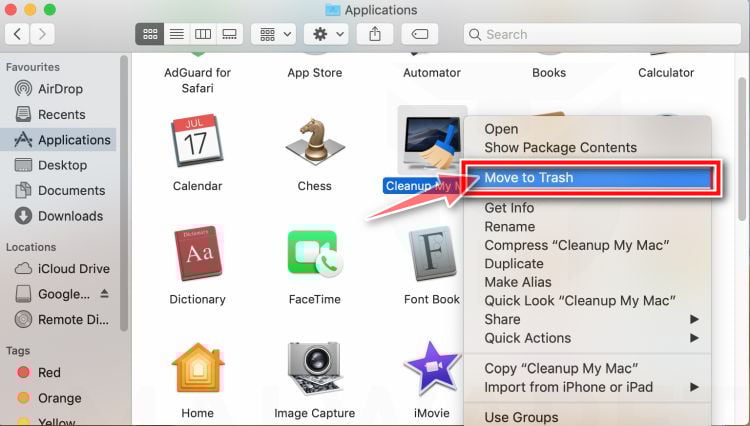
Find and remove the malicious app.
The "Applications" screen will be displayed with a listing of all the app installed on your device. Scroll through the list until you observe the malicious app, correct-click it, and so click "Motility to Trash".
Look out for any suspicious program that could exist behind all the drama – anything you don't remember downloading or that doesn't sound like a 18-carat program. Here are some known malicious programs: TakeFresh, TopResults, FeedBack, ApplicationEvents, GeneralOpen, PowerLog, MessengerNow, ImagePrime, GeneralNetSearch, Reading Cursors, GlobalTechSearch, PDFOnline-express, Meet Scenic Elf, MatchKnowledge, Easy Speedtest, or WebDiscover.
-
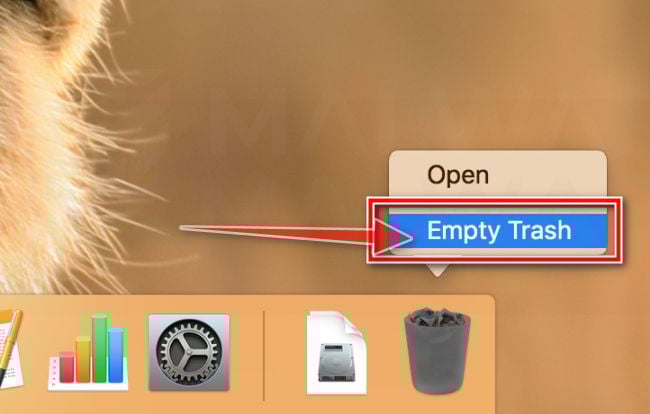
Click "Empty Trash"
On the dock, right-click on the trash icon and select "Empty Trash". Doing so deletes the Trash's contents, including the program that you just sent to the Trash.
-
Check and remove for malicious files
- Click the desktop to make certain you're in the Finder, cull "Get" and then click on "Get to Binder".
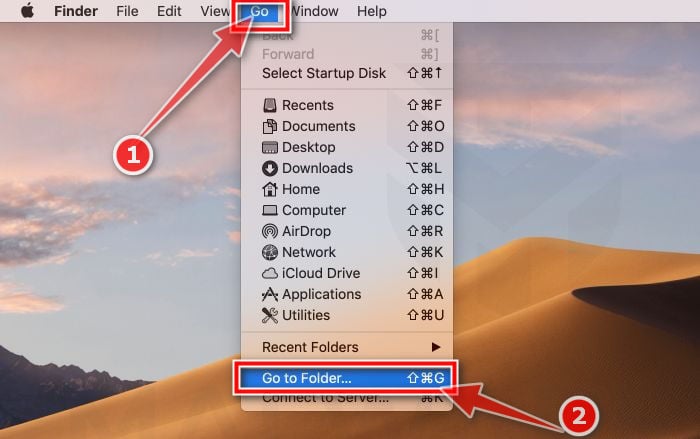
- Type or re-create/paste each of the below paths into the window that opens, then click Go.
- /Library/LaunchAgents
- ~/Library/LaunchAgents
- /Library/Awarding Support
- /Library/LaunchDaemons
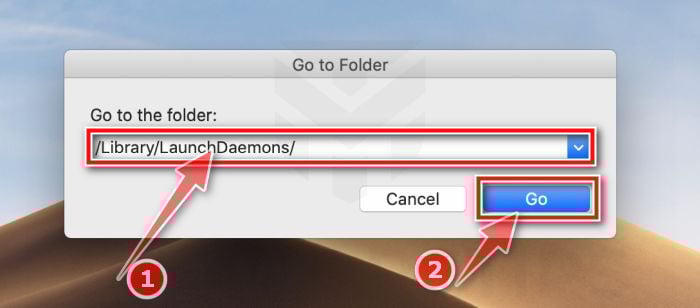
- Look out for any suspicious files that could exist behind all the drama – annihilation yous don't remember downloading or that doesn't sound like a genuine program. Hither are some known malicious files: "com.adobe.fpsaud.plist" "installmac.AppRemoval.plist", "myppes.download.plist", "mykotlerino.ltvbit.plist", or "com.myppes.cyberspace-preferences.plist". When you observe a malicious file move it to the Trash.
- Click the desktop to make certain you're in the Finder, cull "Get" and then click on "Get to Binder".
Pace three: Use Malwarebytes Gratuitous to remove adware and browser hijackers
Malwarebytes Free is one of the most popular and most used anti-malware software for Windows, and for good reasons. It is able to destroy many types of malware that other software tends to miss, without costing you admittedly nothing. When it comes to cleaning up an infected device, Malwarebytes has always been free and nosotros recommend it equally an essential tool in the fight against malware.
-
Download Malwarebytes for Mac.
You lot tin can download Malwarebytes for Mac past clicking the link below.
-
Double-click on the Malwarebytes setup file.
When Malwarebytes has finished downloading, double-click on the setup file to install Malwarebytes on your reckoner. In most cases, downloaded files are saved to the Downloads binder.

-
Follow the on-screen prompts to install Malwarebytes.
When the Malwarebytes installation begins, you will encounter the Malwarebytes for Mac Installer which will guide you lot through the installation process. Click "Continue", and then go along post-obit the prompts in club to go along with the installation process.



When your Malwarebytes installation completes, the program opens to the Welcome to Malwarebytes screen. Click the "Get started" button.
-
Select "Personal Computer" or "Work Reckoner".
The Malwarebytes Welcome screen will first ask you on what type of computer are you installing this plan, click either Personal Computer or Work Computer.

-
Wait for the Malwarebytes browse to complete.
Malwarebytes volition browse your computer for adware and other malicious programs. This process tin can accept a few minutes, and so we suggest you do something else and periodically check on the status of the scan to see when information technology is finished.

-
Click on "Quarantine".
When the scan has completed, yous will exist presented with a screen showing the malware infections that Malwarebytes has detected. To remove the malicious programs that Malwarebytes has found, click on the "Quarantine" button.

-
Restart figurer.
Malwarebytes will at present remove all the malicious files that it has plant. To consummate the malware removal procedure, Malwarebytes may ask yous to restart your computer.

When the malware removal procedure is consummate, yous can shut Malwarebytes and continue with the rest of the instructions.
Click on "Browse".
To scan your reckoner with Malwarebytes, click on the "Browse" button. Malwarebytes will automatically update the antivirus database and outset scanning your computer for malware.

STEP 4: Remove browser hijackers from Safari, Chrome, or Firefox
Safari
Remove malicious extensions and redirects from Safari browser
-
Go to Safari's "Preferences".
On the menu bar, click the "Safari" card and select "Preferences".
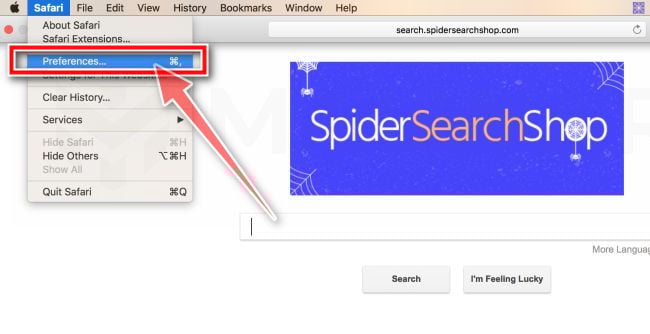
-
Check Homepage.
This will open a new window with your Safari preferences, opened to the "General" tab. Some browser hijackers may change your default homepage, and so in the Homepage field make certain it'southward a web page you want to use as your start-up page.
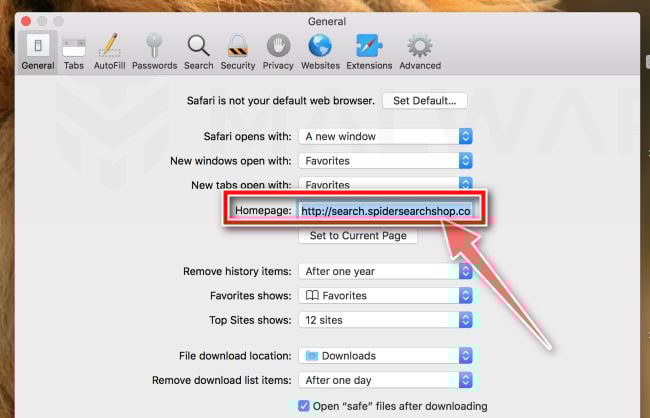
-
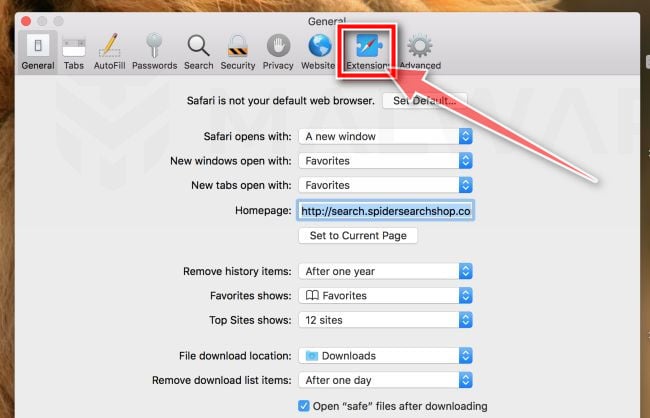
Click "Extensions"
Next, click on the "Extensions" tab.
-
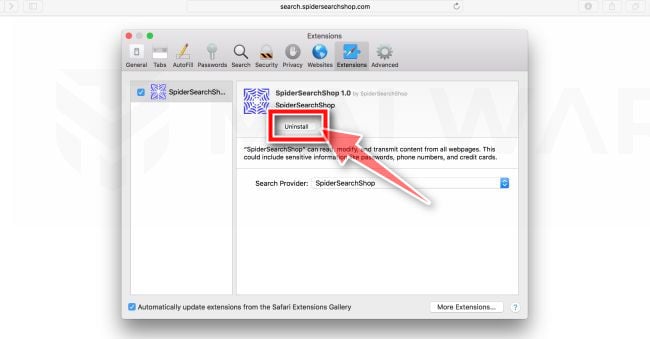
Find and uninstall the malicious extension.
The "Extensions" screen will be displayed with a listing of all the extensions installed on Safari. Scroll through the list until you find the malicious extension, and so click on "Uninstall" to remove it. By default, in that location are no extensions installed on Safari.
Look out for any suspicious extension that could exist backside all the drama – anything yous don't remember installing or that doesn't sound like a genuine browser extension. Here are some known malicious extensions: TakeFresh, TopResults, FeedBack, ApplicationEvents, GeneralOpen, PowerLog, MessengerNow, ImagePrime, GeneralNetSearch, Reading Cursors, GlobalTechSearch, PDFOnline-express, See Scenic Elf, MatchKnowledge, Easy Speedtest, or WebDiscover.
If the higher up steps didn't assist you remove the malicious extensions or redirects from Safari, you lot can follow the below steps:
-
Workaround for greyed out Safari'due south homepage
In some cases, subsequently being changed by adware or malware, Safari's home folio tin can become stuck (greyed out). Y'all volition exist able to edit the Homepage field in Safari's preferences, but the change volition non stick. This appears to be a problems, and there is an odd workaround. Try this:
- In Safari, choose Preferences from the Safari menu.
- In the window that opens, click the General icon (if necessary)
- Enter your desired home page in the "Homepage" field, but DO NOT press return!
- At the top of the window, click any of the other icons (eg, Tabs, AutoFill, etc).
- You lot may see a prompt asking for confirmation for irresolute the home page. If so, confirm.
- Switch back to the Full general page and check to brand sure the home page has been changed.
-
Delete Safari's preferences file to remove malicious changes
Some malicious programs are known to install managed preferences to ready the homepage and search engine settings in Safari. If the above options didn't help you remove the malicious redirects, we'll need to delete the Safari's preferences. To do this, follow the below steps:
- Quit Safari
- Click the desktop to make certain you're in the Finder, choose "Get" then click on "Go to Binder".
- Blazon or re-create/paste the post-obit path into the window that opens, so click Become: ~/Library/Preferences/com.apple.Safari.plist
- If the file is institute, delete it, then re-open Safari
Google Chrome
Reset Google Chrome to remove malicious changes
Google Chrome has an choice that volition reset itself to its default settings. Resetting your browser settings will reset the unwanted changes caused by installing other programs. Even so, your saved bookmarks and passwords volition not be cleared or changed.
-
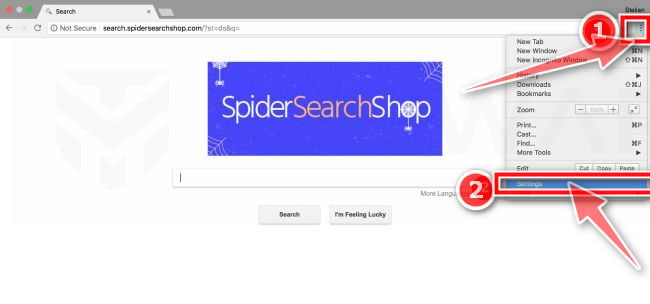
Open up Chrome'southward "Settings" menu.
Click on Chrome's main menu push button, represented past three horizontal lines. When the drop-down menu appears, select the option labeled "Settings".
-
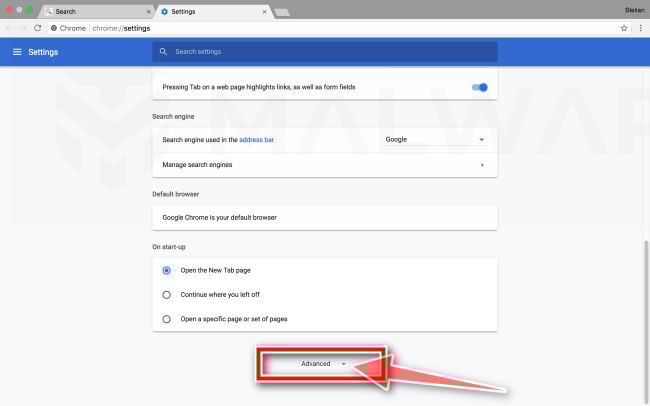
At the bottom, click "Advanced".
Chrome's "Settings" should now be displayed in a new tab or window, depending on your configuration. Next, scroll to the bottom of the page and click on the "Advanced" link (as seen in the below example).
-
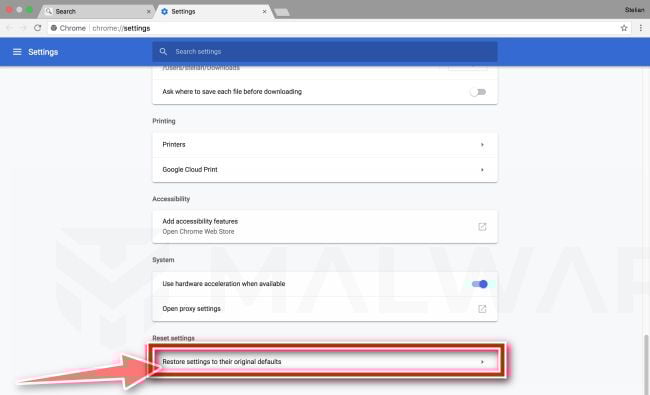
Under the section "Reset," click "Reset".
Chrome's advanced settings should now be displayed. Scroll downwards until the "Reset and clean upwardly" section is visible, as shown in the case below. Next, click on the "Reset settings to their original defaults" button.
-
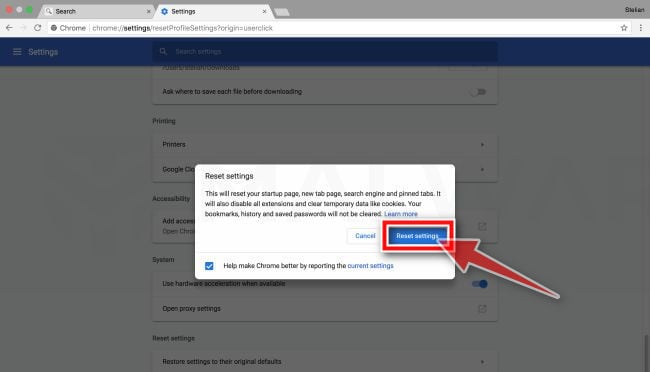
Confirm past clicking "Reset".
A confirmation dialog should at present be displayed, detailing the components that volition exist restored to their default country should you continue on with the reset process. To complete the restoration process, click on the "Reset Settings" button.
If the above steps didn't help yous remove the malicious extensions or redirects from Chrome, you tin can follow the below steps:
-
Remove the unwanted policies created past malware from Chrome
In many cases, changes to Chrome may not exist fixed with a simple browser reset. In such a case, it's very possible that a malicious program has created unwanted policies on your browser. Y'all tin can check if any unwanted policies are loaded into the browser past typing chrome://policy into the URL bar.
To reset these policies, follow these steps:- Open a new Last window. To do this, go to Finder > Go > Utilities > Terminal
- Enter the following commands, pressing enter after each line:
- defaults write com.google.Chrome HomepageIsNewTabPage -bool false
- defaults write com.google.Chrome NewTabPageLocation -string "https://www.google.com/"
- defaults write com.google.Chrome HomepageLocation -string "https://www.google.com/"
- defaults delete com.google.Chrome DefaultSearchProviderSearchURL
- defaults delete com.google.Chrome DefaultSearchProviderNewTabURL
- defaults delete com.google.Chrome DefaultSearchProviderName
- defaults delete com.google.Chrome ExtensionInstallSources
- Afterwards running these commands, quit Chrome if yous haven't already done so, and so launch it again and check chrome://policy to encounter if the same keys are withal nowadays (you lot may need to click the "Reload policies" button for changes to show up). If they're gone, you should exist able to change your search engine and home page back to your preferred defaults in Chrome'due south settings.
-
Remove the "Managed by your system" policy from Chrome
Some malicious programs are known to install managed preferences to set the abode page and search engine settings in Chrome. To cheque for these, do the following:
- Quit Chrome
- Click the desktop to brand sure yous're in the Finder, choose "Become" so click on "Go to Folder".
- Type or copy/paste the following path into the window that opens, and so click Become: /Library/Managed Preferences/
- Paste the below path into the window that opens, then click Go:
Look for the following files, where [username] is your username:- com.google.Chrome.plist
- [username]/com.google.Chrome.plist
- [username]/complete.plist
These may be legitimate, so open these files with TextEdit and see if they take links to the troublesome site in them. If they do, delete them and restart Chrome.
-
Uninstall Google Chrome from your computer
If the above options didn't aid y'all remove the malicious redirects, it is easier to completely remove Chrome and all information, then reinstall the browser. To do this, click the Finder icon, from the bill of fare bar. Choose Get, and click Go to Binder, and so paste one of the below paths into the window that opens.
Y'all will need to delete all of the below items, but before doing this be enlightened that this volition delete all data for all Google apps you have installed, such every bit your bookmarks, and so you will demand to consign them earlier doing this.- /Applications/Chrome.app
- /Library/Application Support/Google/
- /Library/Google/
- ~/Library/Awarding Support/Google/
- ~/Library/Google/
- ~/Library/Preferences/com.google.Chrome.plist
Note: The "~" indicates that it's the current user's Library which is often invisible in recent versions of macOS. To get to information technology you must hold downwards the Pick (sometimes labeled Alt) key downward and select Library from the Finder's Go menu.
After deleting all of the above files, restart your device. You tin can now download and re-install Google Chrome on your device. Yous will need to import any exported bookmarks or other data, and may need to reinstall whatsoever other Google apps that you utilize.
Mozilla Firefox
If yous're having problems with Firefox, resetting it can aid. The reset feature fixes many issues by restoring Firefox to its manufacturing plant default state while saving your essential information like bookmarks, passwords, web grade motorcar-make full data, browsing history and open up tabs.
-
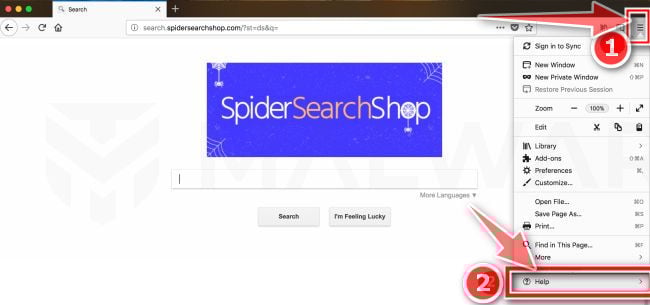
Go to the "Help" menu.
Click on Firefox'due south main menu push button, represented by three horizontal lines. When the driblet-down menu appears, select the choice labeled "Help".
-
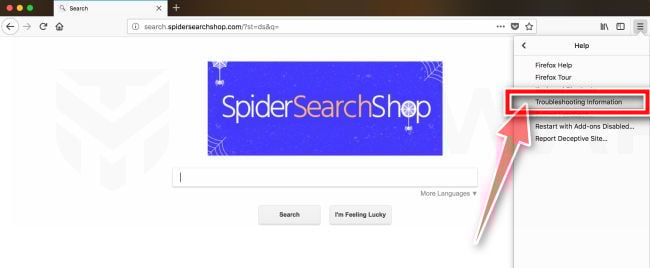
Click "Troubleshooting Information".
From the Assistance menu, click on "Troubleshooting Information".
If you're unable to access the "Help" carte, blazon about:back up in your address bar to bring upwardly the Troubleshooting information page.
-
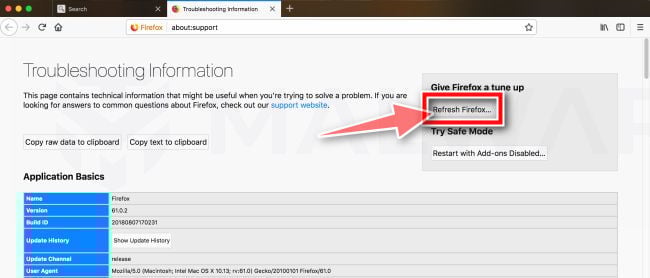
Click on "Refresh Firefox"
Click the "Refresh Firefox" push in the upper-right corner of the "Troubleshooting Information" folio.
-
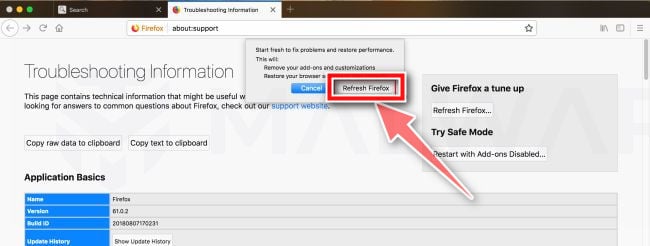
Confirm.
To proceed, click on the "Refresh Firefox" button in the new confirmation window that opens.
-
Click on "Stop".
Firefox will shut itself and will revert to its default settings. When it's done, a window will list the information that was imported. Click on the "Finish".
Your old Firefox contour will be placed on your desktop in a folder named "Quondam Firefox Data". If the reset didn't set your problem y'all can restore some of the data not saved by copying files to the new profile that was created. If you don't need this binder whatever longer, y'all should delete it as it contains sensitive data.
Your computer should at present be complimentary of malicious programs. If your current antivirus allowed a malicious program on your computer, you may desire to consider purchasing the full-featured version of Malwarebytes Anti-Malware to protect confronting these types of threats in the future.
If you are still experiencing bug while trying to a malicious programme from your estimator, please ask for aid in our Mac Malware Removal Assistance & Support forum.

Source: https://malwaretips.com/blogs/remove-mac-os-x-virus/
Posted by: hatchhowely.blogspot.com
0 Response to "How To Clean Your Computer Of Viruses Mac"
Post a Comment